Introduction
Costa Rica’s climate, geography, and building traditions pose both opportunities and challenges for architects, builders, and homeowners. High humidity, heavy rainfall, salt air (near coastlines), seismic risk, and the desire for indoor comfort all influence the smart selection of materials and systems. In this post we explore common materials and systems used in Costa Rica, and offer recommendations for durable, climate-sensitive construction.
1. Key Environmental Factors to Consider
Before choosing materials or systems, these local conditions should guide design decisions:
-
Humidity & Rain: Many regions receive heavy rainfall, and constant humidity can promote mold, rot, or corrosion.
-
Solar heat & thermal comfort: Reducing heat gain and facilitating natural ventilation is critical.
-
Salt air (coastal zones): Accelerates corrosion of metals and degradation of certain finishes.
-
Seismic risk: Costa Rica lies in a tectonically active zone, so structural resilience is essential.
-
Material availability and cost: Importing specialized materials raises cost; local supply and vernacular knowledge matter.
-
Maintenance demands: Because of the climate, materials needing low maintenance are preferred in many contexts.
With these in mind, let’s review common materials and systems and their pros/cons in Costa Rica.
2. Common Materials & Systems (with Pros & Cons)
2.1 Reinforced Concrete & Concrete Block
Pros:
-
Strong, durable, and well understood by local builders.
-
Good mass helps dampen temperature swings (thermal inertia).
-
Resistant to insects, rot, and many forms of wear.
-
Amenable to seismic reinforcement (with rebar, shear walls).
Cons / Considerations:
-
Concrete production has a high carbon footprint (consider greener mixes).
-
Without proper detailing, concrete walls can trap moisture — need drainage, waterproofing, and ventilation.
-
Cracking or shrinkage can be issues if curing is not done carefully.
-
Finishes (stucco, paint) must be resistant to moisture, UV, and biological growth.

Use cases & tips:
-
Use reinforced concrete frames and infill with concrete block (CMU) for walls.
-
Always include proper flashing, waterproof membranes, and drainage paths.
-
Provide movement joints to mitigate cracking.
-
Use quality waterproof paints or mineral plasters.
2.2 Steel Frame / Metal Structure
Pros:
-
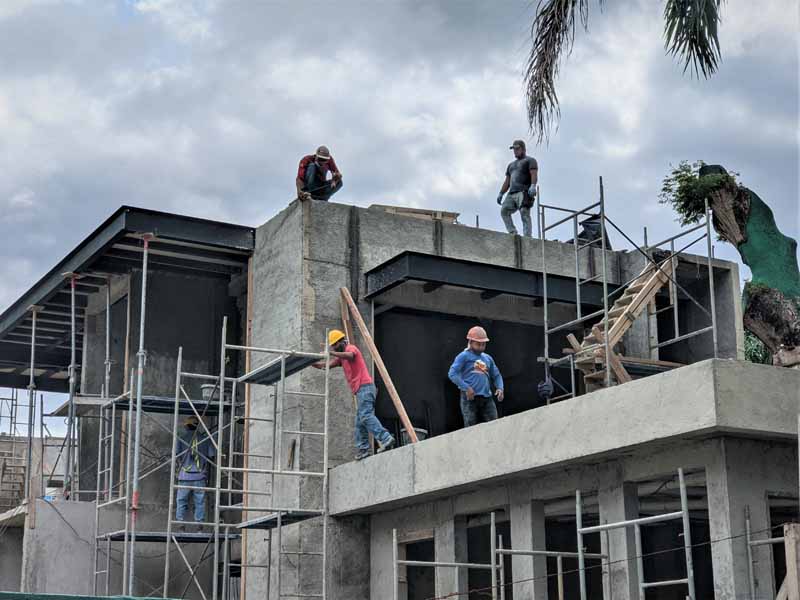
Quick to erect; lighter than full concrete structures.
-
Flexibility in architectural forms and spans.
-
Often easier to integrate services (plumbing, electrical) in hollow spaces.
Cons / Considerations:
-
Prone to corrosion, especially near the coast (must use corrosion-resistant coatings or stainless elements).
-
Must carefully avoid thermal bridging (metal can conduct heat).
-
Hollow walls require good detailing to avoid condensation, mold, or pest infiltration.
Use cases & tips:
-
Use galvanized steel or protected steel beams and columns.
-
Cover with moisture resistive sheathing (cement board, fiber cement) and ventilated cladding.
-
Provide thermal breaks (insulation between interior finishes and steel shell).
-
In coastal areas, periodic maintenance (coatings) is critical.
2.3 Timber & Engineered Wood
Pros:
-
Aesthetic warmth and natural character.
-
Lightweight, which is helpful for certain soils or seismic design if detailed properly.
-
Renewable (if sourced responsibly).
Cons / Considerations:
-
Susceptible to insect attack, rot, warping, and fungal growth unless treated.
-
High maintenance demands (repainting, sealing) under tropical conditions.
-
Structural strength is lower compared to concrete/steel for large spans, unless engineered.
Use cases & tips:
-
Use for non-structural elements (ceilings, decks, exterior accents) rather than primary structural walls in humid zones.
-
Use tropical hardwoods or treated wood resistant to moisture / pests.
-
Ensure good overhangs, drainage, and ventilation around wood to prolong life.
-
Inspect and re-seal finishes periodically.
2.4 Bamboo & Sustainable / Alternative Materials
Pros:
-
Rapidly renewable and high strength-to-weight ratio (for certain bamboo species).
-
Lower embodied carbon compared to concrete or steel.
-
Ideal in ecological or “green” design settings.
Cons / Considerations:
-
Less common in mainstream Costa Rican construction; may require specialized skill.
-
Ends and joints must be well detailed against moisture ingress.
-
Protective treatments are essential to resist rot, insects, and fungal decay.
Use cases & tips:
-
Use as decorative structural elements, pergolas, or lighter roof structures.
-
Combine with more durable materials for base and foundation.
-
Use treated bamboo and ensure protective roof overhangs to shield from rain.
-
Consider hybrid systems (bamboo + steel/concrete) to get best of both.
2.5 Composite / Panel Systems (e.g. insulated panels, concrete + foam cores)
Pros:
-
Good thermal insulation performance when properly executed.
-
Speed of assembly (modular or panelized installation).
-
Possible weight reduction.
Cons / Considerations:
-
Quality control is critical (any flaw in the envelope can lead to moisture problems).
-
Some materials (like polystyrene cores) may degrade in tropical UV or under humidity stress.
-
Repairing damage may be more complex, requiring specialist expertise.
Use cases & tips:
-
Use in mid-rise or higher-end housing where the components are properly rated for tropical use.
-
Ensure all joints are sealed, membranes are continuous, and ventilation is planned.
-
Avoid materials that trap moisture; always allow drying paths.
-
Prioritize local suppliers and tested systems to reduce risk.
3. Recommendations Specific to Costa Rica
Here are some best-practice tips adapted to Costa Rican climate zones, costs, and cultural preferences:
-
Prioritize moisture control & ventilation
-
Always design with overhangs, eaves, and porches to shield walls from rain.
-
Use breathable membranes, drainage planes, and ventilated cavities.
-
Encourage cross ventilation — align windows and openings to prevailing breezes.
-
-
Use durable exterior finishes & protective coatings
-
Use high-quality paints, mineral plasters, or waterproof coatings rated for tropical UV.
-
Avoid finishes that degrade quickly under constant humidity or salt exposure.
-
-
Select materials based on zone
-
Inland highland areas may tolerate more traditional or heavier materials.
-
Coastal zones require extra attention to corrosion, salt penetration, and wind loads.
-
-
Blend local knowledge and imported innovation
-
Use local materials and construction techniques when possible (lower cost, better familiarity).
-
But don’t shy from imported systems if they offer energy/maintenance advantages — just ensure they are adapted for tropical performance.
-
-
Design for phased maintenance
-
Assume periodic maintenance (coating steel, resealing wood) is inevitable in this climate.
-
Make those interventions easy (access, replaceable elements).
-
-
Employ good structural design
-
Work with structural engineers to ensure seismic and wind resilience.
-
Use reinforced cores, shear walls, or braced frames in concrete or steel systems.
-
-
Control costs wisely
-
Invest more upfront in a robust envelope rather than cheap finishes that will degrade.
-
Bulk purchase local materials when possible to lower transport/markup costs.
-
Use hybrid systems (concrete + steel + wood) to optimize cost, performance, and aesthetics.
-
4. Example Outline of a Climate-Smart House
Here’s a conceptual system combining the materials above, adapted for a coastal tropical site:
-
Foundation & base: reinforced concrete footing and slab, with proper drainage.
-
Primary structure: a mixed system: reinforced concrete or concrete columns and beams, infilled with concrete block walls or structural insulated panels.
-
Roof structure: steel trusses or laminated timber, with generous overhangs.
-
Roof covering: metal roofing or clay tiles (with corrosion-resistant coating) plus underlay membranes.
-
Exterior walls: block or concrete walls with plaster + waterproof paint. In portions, ventilated wood or composite cladding detailing.
-
Windows & doors: aluminum or fiberglass frames with corrosion resistance, louvered windows or operable shutters for ventilation.
-
Interior finishes: moisture-resistant boards (cement board, fiber cement, gypsum board) and finishes that tolerate humidity.
-
Protection: gutter systems, flashings, site grading to divert water away from walls, insect screening, shading devices.
This hybrid approach balances durability, thermal comfort, aesthetics, and maintenance demands.